Showing posts with label primal. Show all posts

Thursday, June 28, 2012

Reader Testimony: Bob W.

Check out Bob W., a client at CrossFit King of Prussia and a different man from 8 months ago! Below is his story and details of his workouts and nutrition. I've edited some things for format and emphasis, but the content is all from Bob. 

Bob W. Pre-Paleo and Pre-CrossFit
Name: Bob W. 
Age: 31
Height: 5'10"
Weight before: 250 (10/22/2011)
Current weight: 195

 Hey Chris,


Here are some details about what I have been doing/eating/lifting over the past 8 months.  For a solid timeline, I joined my "globo gym" for my 31st birthday, October 22nd 2011.
I started "Paleo-ish" once around Christmas 2011, gave up on it fairly quickly, then started back on it pretty strictly around February of this year. The last 3 months or so I have been pretty much 95% paleo.

When I first joined the gym my workouts were pretty traditional.  I did some TRX with a trainer, jogged on an elliptical as much as I could, and lifted weights at a low weight/high rep interval.  At that point I was just trying to get active again and start to even be READY to get back into shape!  My knees hurt, I couldnt do much, it was pretty bad.

My diet before was the big issue obviously.  My portion size was giant and I ate crap.  Not fast food so much, but just a ton of pasta and hoagies and heavy sauces. I was a carb-a-holic. Typical breakfast was sometimes a breakfast sandwich or similar,  lunch was usually cheesesteaks or hoagies, dinner was pasta and meatballs etc.  Obviously I didnt eat this stuff everyday, but it was a majority of the time and in far too big proportions.  In addition, a few years ago, I stopped drinking alchohol pretty much cold turkey.  You might think that I would lose weight from that, but I think my body was so used to elevated blood sugar levels that a major sweet tooth developed when there hadn't been one before.  I ate a lot of ice cream and cakes and cookies. I also ate whatever my kids were eating, which tended to be processed chicken fingers, mac and cheese, etc.  I bet I put on 10lbs a year for the fours years after my oldest son was born.

My diet now is pretty on point.  I eat an omlette with two omega-3 eggs and some eggwhites plus some kind of vegetable almost every morning.  When its not that its cold fish/chicken/steak from the night before with a veggie or handful of berries.  Snacks are jerky, some nuts, maybe and organic plain greek yogurt (I know, I know) on workout days.  Lunch is typically a big piece of meat/fish grilled up with vegetables.  I've found a number of paleo-adherent condiments to keep it interesting.  Dinners are again a big protein with a big salad (lemon juice and avocado oil dressing is the bomb) and MAYBE a sweet potato. I always add good fats like avaocado etc.  If I need something sweet later, its usually a small spoonful of organic "no sugar added" peanut butter with some berries.  A couple weeks ago Sara grilled me some bananas and drizzled a little high quality melted 90% cacao chocolate on them, it was awesome.  We eat a TON of shellfish and seafood. I go grass-fed and natural when I can, although its not 100% feasible with the quantities of food a family of five eats.  We already drop $400/wk at the grocery store so I take what I can get!  There are enough websites and cookbooks for paleo eaters right now that its pretty easy. Luckily my family has been super supportive of this and they actually eat much better now too.  They often have a bread/rice/pasta dish which I just pass on, no big deal.  I take a multivitamin, probiotic, and BCAA'a and I work outside so I get a lot of excercise during the days and lots of sunshine.  I'm working on sleeping more, thats my biggest failure.


My workouts now are dynamic, fun, and a work in progress.  I do CF KoP 2-3x per week in additon to recently adding a couple strength days (Wendler 5-3-1, body weight accessory work).   When the weather is right and I want to run I'll do CFE (CrossFit Endurance), main site WOD's, or just tabata/HIIT sprints for 12 minutes max.  I am able to do all this either at 6AM or after the kids (ages 5, 4, 1.5) go to bed so I don't take away from our time together.  In addition I work 50-55hr weeks and my wife works weekend nights.  Beyond that I'm in Grad School!!!   If I can do this literally anyone can. For my birthday this year I am getting myself one of those Rogue garage gym packages with bumper plates for my garage so I can lift heavy whenever I get time.  Oly lifts have become my favorite, I love how technical they are. I hung a pullup bar in a doorway off my living room and I dont walk under it EVER without doing 5 chinups.   I call it "muscle-toe"!


Basking in his leaned out (sunburned) glory?
The main resources I have used to make these changes are, not to be too cocky, but my own dedication and determination.  That coupled with equal parts love and support from my wife and kids.  This whole thing has been as much for them as me.  I'm am a better dad and husband now, happier and more vibrant.  Physically my body has NEVER been more well rounded.  I'm stronger, faster, leaner, more flexible.  I could not do a pullup 8 months ago now I can do 12 strict dead hang in a row. I'm SOOOOO close to a muscle up.  This allows my body do do basically whatever my mind tells it to, which is HUGE with young kids and an active lifestyle.  Mentally I'm happier, clearer, sharper, more focused.  I'm confident I can do whatever I put my mind to.  I don't want to totally discount the whole "long duration cardio and light weight/high rep" scheme becasue it got me started on this path.  In addition I was eating a more traditional low-fat whole grain heavy diet, with which I did in fact lose weight.  I'm pretty sure that at that point anything I did to sweat and eat less would have been an inprovement, but still I don't want to slam the methods that got me going.  What the CF/paleo transition did for me was switch me physically and mentally into the next gear, and make my changes less of a "diet" and more of a lifestyle.  I'll never gain that weight back (may never lose anymore either, don't care, I want to get stronger and faster and leaner and more powerful!!)  becasue I am more mindful and aware of my body everyday now.  I am aware of how incredible I feel when I give my body lots of what it was designed to take in and nothing it wasn't.  I am aware of how great it feels to work my body the way a hunter/gatherer worked, in short burst of explosive effort followed with plenty of rest and recovery.  My family is actually eating and living better becasue of it.  It really has made a huge positive impact on my life!!


There it is, the brief version!  If you need anymore details or pictures I have tons of both, don't hesitate.  Also remember that you did my "on ramp" and KoP and, while I was avoiding sugar etc before, your blog really got me going and interested in Paleo its overall benefits and effects.  I have you to thank in a big way for all this!! 
                                                                      -Bob


Bob and his motivation
Bob's story is all too familiar, at least in the beginning. Family man whose high carb, high sugar diet caught up to him, even with working outdoors and having a workout routine at the globo gym. His story aligns with the idea that how you look is 20% physical activity and 80% what you put in your mouth.  (some would even say 10/90 or 0/100!) So no, being on a treadmill for an hour or even doing high intensity exercise won't matter if you don't change your nutrition. The fact is, when people cut out pasta and bread and sugar, not only do they lose weight, but that "puffiness" in their faces goes away too. That's the inflammation going away, and yes, I had it too (see "You've Got a Fat Face")

 A chief complaint from people is that they can't afford a CrossFit membership. Bob shows that you can get a great workout in by just doing some sprints, modified workouts at a globo gym, and when you can afford it, get to a CF gym for solid coaching. I love that Bob is now into Oly lifting and his clever re-naming of mistletoe for his pull up bar. And I agree with him on not getting down on the cardio/typical gym routine, because frankly it's better than nothing! Bob shows that despite a busy work schedule AND going to grad school AND having 3 kids, it IS possible to hone in on your workouts and nutrition. But the motivation has to come from within and it always helps to have the support of loved ones. He does this for himself, but more importantly he does it for his wife and kids. No doubt he is and will be an amazing role model for his kids to brag about to their friends. 

If you have a testimony to share or if you'd like a nutrition or fitness consultation, email me at chris@crossfitkop.com 

Wednesday, June 27, 2012

Ghee: What Is It? Why Should I Use It?

You may not have heard of ghee (pronounced with a hard "g" and silent "h") before, but when it comes to Paleo/Primal cooking, you'll find it's a staple in many kitchens. Let's take a closer look at what it is, why it's good for you, and how you might use it. 


WHAT IS GHEE?
Take grass-fed butter, heat it up to evaporate the water and let the milk solids settle to the bottom. Remove said milk solids and voila, you've got ghee. It was traditionally used for cooking in many south Asian countries such as India, Nepal, and Pakistan, but now has moved into Paleo kitchens around the world. You can actually make your own ghee like Nom Nom Paleo does, but I prefer to save time by buying it from Amazon.  Typically ghee is a solid at room temperature, looking just like butter. These pictures are right after I got it shipped to me in some hot weather, so it's a liquid here. Since the water and milk solids are not present, ghee can be stored at room temperature for months! For more on the amazing history of ghee, head over to Whole30. Did you know traces of ghee have been on pottery from 6,500 B.C.?!


WHY SHOULD I USE GHEE?
Ghee is primarily saturated fat, and by now we should all love and cherish saturated fat from grass-fed animal sources. Also, since 99.9% of the milk solids have been removed, many people allergic to casein and lactose do perfectly fine with ghee. I'm not sure if I believe in a perfect food, but this is darn close! 


WHAT WOULD I USE GHEE FOR?
I use ghee most of the time for cooking, especially sautéing, frying, etc. Basically if a recipe calls for vegetable oil to coat a pan, I use ghee. You really haven't lived if you haven't coated a pan with ghee and then fried your eggs in it. (Ok, well, maybe if you've fried them in bacon grease) I also use olive oil and coconut oil on occasion, but ghee just tastes so darn good (like buttah!) plus it has a higher smoke point due to the lack of milk solids and water. You can also use ghee in any application you would use butter. Sometimes if we have run out of Kerry Gold butter, I'll put ghee on my baked sweet potato. Or I'll even put it in my coffee with coconut oil! And I'm not gonna lie, I've been known to just drink ghee straight out of the container. The possibilities are endless!


Monday, May 14, 2012

Gary Taubes on America's Failure to Stop Obesity

Usually if I find an interesting article on the interwebs, I'll Twitterize it. But since Gary Taubes is a well known figure in the obesity world and this article is written so anyone can understand it, I wanted to share it via the blog. Here is his Newsweek article "Why the Campaign to Stop America's Obesity Crisis Keeps Failing."  In it, he describes HBO's new four-part series The Weight of the Nation. Although the creators have good intentions to address America's obesity, it still relies on old-fashioned thinking: calories in should equal calories out, you should exercise to lose weight, etc. 

I eat a lot of meat with plenty of saturated fat...
...so that means I must be really fat!
Taubes has already addressed these issues ad nasium in his books Good Calories, Bad Calories  and Why We Get Fat.  He, and other paleo/primal gurus such as Mark Sisson, Robb Wolf, and Kurt Harris, have all addressed the fact that calories are not created equal and despite the recommendation to be active and exercise, it will not impact your weight/fat loss as much as your nutrition. I know, I know, it's hard to believe that 1000 calories of cupcakes does not equal 1000 calories of meat and vegetables. And no, that elliptical you were on for an hour will not help you lose weight. I address this in my post Skinny-Fat, Cortisol, and Why Cardio Doesn't Work.

If this is all news to you and if you want to read more from Taubes, pick up Why We Get Fat if you the average Joe Schmoe and need things in plain English. If you are a biochemistry nerd, or love citations, then hit up GCBC. But if you are in fact a biochemistry nerd with a preference towards paleo/primal eating, then you probably have already read GCBC. 

If Paleo/Primal is new to you, then head over to my Paleo 101 post. Keep reading and learning, as doing so will help you make your own decisions when it comes to food and nutrition. It's one thing to eat a certain way just because someone tells you to. It's a different thing when you know WHY.


Monday, April 9, 2012

Catching Up on Some Light Reading

Yesterday, Ditty and I just got back from Iceland. It was an awesome place with a ton of outdoor sights: volcanoes, geysers, and waterfalls galore. Pictures are coming. While we were away, I didn't do any of my usual blog reading, so here are a few things that I'll need to catch up on. Check them out if you haven't already.


(this post was inspired by Kurt Harris' post)

Monday, March 26, 2012

Weird Guy in the Office

bone broth/grass fed roast soup and brussel sprouts
Are you that weird guy/girl in the office who brings ...::gasp::... *real food* for lunch? You know what I mean, instead of heating up that Hot Pocket or Lean Cuisine, you have a lunch bag full of meat, veggies, and fruit. Do people ask you about it or leave you alone? If they do ask about it, how far into the Paleo/Primal schtick do you go? Or what other angle do you take when confronted about your weird food? 


Don't even get me started on drinking coffee black...

Tuesday, March 6, 2012

What Is the Paleo Diet? Paleo 101

You or someone you know wants to learn what this whole "Paleo" thing is all about. You've heard about it from friends raving about how they lowered their cholesterol, dropped pant sizes, and stopped taking their diabetes medicine. You've seen it on Facebook, Twitter, and now the media is covering stories about Paleo. Well, this is the post for you. 


This post is intended for the beginner who heard about this "Paleo" diet and wants to know more. When I did a Google search for "what is the paleo diet" I found some great resources, but ones that were either too long or focused too much on the wrong things in order to explain what Paleo is. You'll find many different definitions and viewpoints (both good and bad) about the Paleo diet, but I try to break it down nice and simple here so brand new people can get an understanding for what it's all about. Let's dive in and see what the Paleo Diet is and is not.

HISTORY
The Paleo diet is typically explained as trying to emulate the diet of our paleolithic ancestors. By doing so, we are consuming foods that our body have evolved to accept and avoiding foods that our bodies would reject. I will go into this idea further down below, but for now, this is a basic explanation. Many people familiar with the Paleo Diet would say it was popularized by Dr. Loren Cordain and Robb Wolf, but Walter Voegtlin actually suggested in 1975 that the ideal human diet should emulate that of our ancestors'. Since then, many people have popularized this idea of an ancestral diet or similar diets, such as Mark Sisson, Art Devaney, Weston A. Price Foundation, Kurt Harris, Dallas and Melissa Hartwig, and Mat Lalonde.

MY DEFINTION
Paleo is not hard. There are no magical secrets, but rather, consistency. If you've ever had eggs and bacon for breakfast, you've eaten paleo. If you've ever had a salad and steak for dinner, you've eaten paleo. It's just that most people include grains, extra sugar, and other processed foods. Here is my take on what Paleo is:

"Paleo, or paleolithic nutrition, is an anthropological and scientific template for eating real, whole foods and avoiding inflammatory ones. But like all templates, it should be examined and then tweaked for one's needs." - Chris Plentus, Constantly Varied
 
NomNomPaleo's interpretation of MyPlate

5 Things about Paleo that are TRUE:
1. "Paleo is a recommendation for eating real food" - at it's very base, Paleo is about the QUALITY of food. To find out if food is generally good for you, consider if: it grows and dies; it can be found in nature; it goes bad; it has been around for generations. If you need a factory to make it, it's not food! In general, you'll be eating meat, fish, vegetables, fruit, spices, and nuts/seeds. You might think that this is too limiting, but I bet there are foods that you haven't even tried yet!

2. "Paleo is scientifically founded" - Paleo is not just eating what cavemen ate. In fact, very little food around today is the same as 50,000 years ago. Instead, we need to focus on what is biologically and chemically good for our bodies. Scientifically there are foods that are better for the human body and things that are harmful. Real, naturally occurring food is generally better while processed food is not. This is not just pseudo-science, this is the real deal! Links at the bottom of this post will lead you to more discussion about the scientific evidence.

3. "Paleo avoids grains" - this is where most people get off the boat, especially the conventionally "healthy" crew. In short, grains (wheat, barley, oats, rye, corn, etc) contain a number of things that are scientifically harmful to humans: gluten, lectins, phytates, and anti-nutrients being the most common. These things damage the gut lining, are pro-inflammatory, and can cause diseases that you wouldn't even realize. The argument for grains is that they are "heart healthy" and "whole grains are good for you." There is in fact, no science that back these claims, but more just "whisper down the lane" conventional wisdom that keeps grains around. If you look at the nutrition profiles of vegetables, they are powerhouses of vitamins and nutrients compared to whole grains. For those that are skeptical, I am not going to re-invent the lightbulb, but rather, send you over to Mark Sisson where he takes the most common arguments FOR grains and debunks them with scientific links and literature.

4. "Paleo avoids dairy" - This would be the main issue separating a "Paleo" diet from a "Primal" one. I mentioned a number of people associated with ancestral diets above, and many of them differ on the issue of dairy. At a basic level, adult humans did not evolve to drink another animal's milk. However, some experts agree that if the source is grass-fed and the person is not allergic, some dairy could be fine. While dairy is technically not Paleo, it IS supported by the Weston Price Foundation, Mark Sisson, and other highly regarded experts. They would all agree that grass-fed is absolutely better than conventionally grain-fed dairy.

5. "Paleo has been known to reduce or even cure diseases" - While this is not a medicine per se, it makes sense that feeding your body with natural food will typically have it respond in a favorable manner. For instance, there are plenty accounts of people's diabetes going away (their insulin is managed incredibly well on a paleo diet); fat loss is very common (for many different reasons); and even things that you may not associate with food lessen or even go away: ADHD (gluten free anyone?), Alzheimer's, rheumatoid arthritis, and yes, even acne, as my friend Laura Pappas has discussed. In terms of fat loss, now there is no need to count calories because nature has a funny way of maintaining insulin levels and leptin sensitivity (the "feeling full" hormone). If we eat protein and fat, we feel full longer. You simply can't eat a ton of calories of spinach. Thank you nature!

Pasta? No way. Spaghetti Squash.

Things about Paleo that are FALSE or MISLEADING:
1. "Paleo is the way cavemen ate" - Yes, this is a nice and tidy heuristic for explaining Paleo to grandma, but it is NOT the be all, end all. While we can use this idea as a framework, it should not be the rule of eating. In other words, just because it's paleolithic does not make it "good;" conversely, just because it's neolithic does not make it "bad." Here are two examples: our paleolithic ancestors had honey available to them, but this does not mean we should eat a pound of honey. The reverse is true too. "Cavemen" did not have ghee (clarified butter) but experts would agree that it is a great thing to cook with and consume. Our ancestors also didn't have the internet or cars, but it doesn't mean we shouldn't use them.

2. "Paleo is low carb" - this one is super misleading. When people hear that grains are harmful (not just to celiacs!), they say "where do you get your carbs?" Carbohydrates can come in the form of vegetables and fruits. Yes, your diet will probably be lowER in carbohydrates, but it does not mean you have to live VLC (very low carb) or no carb. In fact, for CrossFitters or people who are involved with glycogen-demanding activities, higher carb is going to be better. These carbs are best served in the form of sweet potatoes, white rice, and squash.

3. "Paleo is high protein" - again, not true. Although you might know a lot of CrossFitters who eat a ton of protein, this is their choice of tweaking the macronutrient profile of their food. Remember, Paleo describes the QUALITY of food, not the QUANTITY. Yes, you can even be vegetarian and paleo, or even vegan and paleo. Personally I don't think these are best choices for health and longevity, but you CAN do it.

4. "Paleo is a diet" - If by "diet" you mean a short term way of losing weight to look good for bikini season, then no, I would not go in with mentality. This is not a cleanse, not a crash diet, not a way to starve yourself. However, if you mean "diet" as in an everyday manner of eating that is sustainable, healthy, and live-able, then yes, it's a diet. There's a difference between regular car maintenance and car wreck repair. Same for eating.

5. "Paleo has a hard and fast set of rules" - This is probably the most frustrating thing when discovering what Paleo is. Yes, there are lists of Paleo and non-Paleo foods out there, but these are meant to guide you and offer you ideas for foods that you may not have thought of. Something to know is that there is NO perfect food out there. (and certainly no "super foods" such as the over-hyped acai berries). So don't even bother with "is this Paleo? is that Paleo?" Use your noggin and do some of your own thinking.  Do what works for you. As I mentioned above, some people can consume a little dairy in the form of butter, cheese, even milk. Is this technically Paleo? NO! But is it going to kill them? Probably not. I eat grass-fed butter and lots of animal fat, so does that make me not Paleo? Some hardliners would say so, but that's ok. When you do your research, you're going to be confused and probably want a black and white answer. Well heads up cowboy (or cowgirl), you're not getting one. Everyone's situations and needs are different, so what works for one person might not work for you. You might agree that raw broccoli is good for you, but for the person with a thyroid problem, it's a very bad thing. Paleo is contextual!

a classic favorite: Mexi Salad

 At one point, I was against using the term "paleo" because too many people think of the caveman reference as the only heuristic. However, I've realized it's too ubiquitous to ignore. The term is unique and draws attention to some guidelines for eating rather than a specific one-size-fits-all diet. It's very easy to catch someone's attention by mentioning Paleo rather than "anti-inflammatory, insulin sensitive diet."So although I've now embraced using "Paleo," there is much latitude and context within that term, especially when it comes to things like dairy, rice, beans, etc.

I'm going to leave you with my definition of Paleo again. It's probably not the best one out there, but I think it works and encompasses the ideas of using science to figure out what is better for our bodies, while allowing individual circumstances to guide our food choices.

"Paleo, or paleolithic nutrition, is an anthropological and scientific template for eating real, whole foods and avoiding inflammatory ones. But like all templates, it should be examined and then tweaked for one's needs." -Chris Plentus, Constantly Varied

Since you're probably reading this as a beginner to Paleo, check out the links below for more information and leave any questions you have in the comments section. 

THE NEXT STEPS (previous blog posts that will help you)

PALEO BASICS

BOOKS

COOK BOOKS
Everyday Paleo

Sunday, February 26, 2012

Paleo Summit: Who Doesn't Like Free Info?

If you've been interested in learning more about the Paleo/Primal lifestyle, but don't have the means or the money to attend seminars held across the country, here's your chance to hear from the big names in the Paleosphere. The Paleo Summit is a multi-day event held ONLINE hosted by Underground Wellness for FREE. There are keynote speakers such as Mark Sisson, Mat LeLonde, Dallas and Melissa Hartwig of Whole9, and many more, and Youtube videos available each day. Each day features two or three of the biggest names in Paleo research, medicine, and movement. Today was the first day of presenters (Mark Sisson and Diane Sanfilippo) but you can still catch the next seven days of presenters. Get to it! (click the picture below)


Thursday, January 26, 2012

Liver: the Paleo Superfood You Should Be Eating

Liver. Just the mention of the name sends shudders down people's spines. It functions as a vital organ in animals and humans, but is it really something we should be eating? Let's take a look. 

Chuck Norris rarely ate, but when he did, it was liver

LIVER: A NUTRIENT POWERHOUSE
You may not realize it, but eating organs is one of the best things you can do for health and longevity. Hunter-gatherers even favored the organs while throwing muscle meat to their dogs. Rich in protein, vitamins, and minerals, organ meats may not be palatable, but they are certainly good for the body. Liver in particular is one of the best organs to chow down on. It's a great source of CoQ10 (important for heart health), contains high quality protein, and is one of the best sources of iron and vitamin A. If you were to compare the amount of vitamins in liver to fruit and vegetables, it's like comparing a Ferrari to a Dodge Neon. Both will get you what you need, but one is supercharged. Case in point: check out the chart below from Paleo Cafe. You'll see that liver has 3x potassium compared to an apple, 4.5x the amount of vitamin C compared to a carrot, and a whopping 1,335x the amount of vitamin A compared to red meat. The next most concentrated source of vitamin A is carrot juice (source: USDA)

holy nutrients, Batman!

WANT TO RUN/SWIM/WOD LONGER? EAT LIVER. 
 Liver is also known for its mysterious anti-fatiguing effect. A 1975 article published in Prevention magazine described the experiment as follows:
"After several weeks, the animals were placed one by one into a drum of cold water from which they could not climb out. They literally were forced to sink or swim. Rats in the first group swam for an average 13.3 minutes before giving up. The second group, which had the added fortifications of B vitamins, swam for an average of 13.4 minutes. Of the last group of rats, the ones receiving liver, three swam for 63, 83 and 87 minutes. The other nine rats in this group were still swimming vigorously at the end of two hours when the test was terminated. Something in the liver had prevented them from becoming exhausted. To this day scientists have not been able to pin a label on this anti-fatigue factor." (Weston Price Foundation

Are you kidding me?? Swimming 9x longer and having the experiment actually end before they could find out what happened with those remaining nine rats is astonishing. If you are a triathlete, CrossFitter, or just a HUMAN BEING, this should inspire you to eat liver.

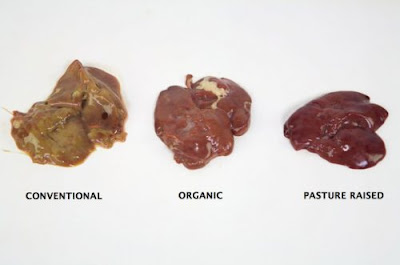
NOT ALL LIVERS ARE EQUAL
In high school and college, you probably saw those pictures of human livers from alcoholics compared to healthy person's. The same can be considered for animals. Make sure you're choosing healthy, vibrant, red liver when about to chow down. If reading this is not enough to convince you, check out this picture.

I know which one I'm picking

MAKING LIVER TASTY
Yes, I realize the thought of eating liver is still gross. There are a lot of recipes out there in the paleosphere and beyond that can help with your aversion to this superfood. Two of the main things you'll usually find in a liver recipe? Bacon and butter. Yum. Knowing this, I made my own liver pâté. (yes I searched how to get those symbols over the "a" and "e.") The liver is from a shipment from PhillyCowShare. They had a box of cow parts that no one really wanted (liver, heart, tongue, tail) so I took it. Score!

1. Gather tasty ingredients. Amount is up to you, but here is what I used: 
3 strips of bacon
1/4 chopped onion
4 cloves of garlic
2 Tbsp. butter + another 2 Tbsp. later
1/2 lb. grass fed beef liver

2.  First, I cooked the bacon. Then I took the strips out, but kept the bacon fat to saute the onion.

3. Then, I added the strips of liver in with the onion to cook. It probably took about 2 minutes each side. Then I added the bacon back in. (Note: At this point you can eat the liver like steak. I will most likely do this next time)

4. If you're going for more of a pâté, then throw all of this in a food processor or blender and whirl away. Store in a refrigerator for 30 min. or so to let it cool down, and then serve on carrots, peppers, or if you're not 100% paleo, on crackers or chips.

So now you know why liver is so good for you AND you have a recipe to make it a little more palatable. Bacon and butter truly make everything better. But if that's still not enough, check out the links below for more information about liver and some recipes too.

Links:
Weston Price Foundation: The Liver Files
Balanced Bites: Chicken Liver Pate

Thursday, January 19, 2012

Paula Deen and Type II Diabetes: Helping or Hurting the Paleosphere?


By now you have heard of Paula Deen and her recent "coming out" about her Type II Diabetes. Plenty of people are on both sides of the issue. Here is a really quick breakdown of the main points and my reactions. If you want to read more detail, head over to a good summary article by the Huffington Post:

Paula Deen Diabetes: Star Confirms Diagnosis, Drug Endorsement


-Deen confirmed rumors about her Type II diabetes on the Today Show earlier this week. She was diagnosed three years ago, but kept it a secret until now, explaining "My knowledge about the disease was very limited," she told USA Today.
 Let's call this for what it's worth. She clearly didn't come out with this information to her viewers for publicity reasons. The same reasons that she is facing criticism now. There have been rumors for years about her diabetes, but none of them were confirmed until this week. I do wonder what her diet has looked like over the past few years though.

-Deen says her stance on food has been and will continue to be "moderation."
 Wait, your stance on food has been moderation, yet you end up with diabetes? Seems a little off to me. At one point she says to a newspaper, "You don't want to make a steady diet of just lettuce...You don't want to make a steady diet of fried chicken." This all or nothing perspective on food is precisely what's wrong with a lot of people's thinking. That, and misinformation about what is healthy and what is not.

Caramel cake from Paula Deen
-She and her two sons are now contracted spokespeople for a diabetes medication called Victoza. 
I can't believe that this woman is openly promoting recipes that include a caramel cake (two full cups of sugar in the cake, three cups of sugar in the icing) and then getting paid millions of dollars to promote a diabetes medication. This is like being the guy who throws a strip of nails out in front of your car and then walks over to you and says he's a mechanic. Well, actually that he KNOWS a good mechanic and that he uses him. Every day. By injecting himself with needles. I digress...

-Critics of Deen are not surprised, especially with all of the butter and sugar she puts in her recipes.
My biggest problem with this whole story is not with Deen, but with her critics. Let's be honest, no one's surprised that she has Diabetes. In fact, I wonder how many other chefs and TV personalities on the Food Network also have it or some other metabolic syndrome. But when people look at her recipes, they immediately focus on the "artery clogging" fat while lumping it together with the "fattening" sugar. I agree wholeheartedly with the latter. But blaming her diabetes and fat gain on eating fat is just misdirected assumptions. It's Ancel Keys all over again. (Ready more about Keys and his scapegoating fat over at Lean Gains) People focus on the butter in her recipes, but it's not the butter! (Now, I wish it was grass fed butter, instead of chemically unstable margarine or regular butter, but a blogger can only be so choosy.)

Lady's brunch burger - scapegoat for the wrong reasons
So, what's the whole point of this blog post telling you things you could find on any news website or gossip column? The next time you're at a happy hour and the topic of Paula Deen comes up, be a defender of the fat. Let people know that eating fat does not make you fat. Sugar, yes. Fat, no. Eating fat helps brain function, joint mobility, cellular reproduction, immune response, and a ton of other things you probably want. This fat should be in the form of saturated animal fats, avocados, coconut oil, ghee, lard, etc. Basically, if someone offers you the Lady's Brunch burger, kindly ask them to take the doughnuts off and you'll gladly eat the rest. 

Here's a great clip from the documentary "Big Fat Lies" on fat and why it's GOOD for you, not BAD:

Tuesday, January 3, 2012

Grass Fed Beef from Philly Cow Share

At CrossFit King of Prussia, we participate in Philly Cow Share. Since you should already know the benefits of eating grass fed beef (cows that eat grass vs. grains are healthier, resulting in better omega-3:omega-6 balance and thus better lipid profiles, reduced inflammation, etc), it's no surprise that health-conscious CF folks try to eat quailty meat. 

Mmmmmh. Beef.
Philly Cow Share works like this: as a group, we each buy part of a cow. Typically each share is 1/8th, or about 43lbs. of grass fed beef. (Some people decide to split shares if they live alone or want to keep costs down) For our gym, we wait until we have 8 shares worth of people and then order a cow. Although we could buy eighths by ourselves from their website, it's cheaper to pay the price of a whole cow at once. Philly Cow Share then gives us a delivery date and delivers the beef by truck directly to our gym. The shares come vacuum sealed with 20lbs. of ground beef and 23lbs. of steaks, beef cubes, and roasts. Ditty and I manage to fit all 43lbs. of beef in our freezer, even with other meat and vegetables in there, but some people go out and buy a chest freezer. 

A car seat for beef.
About their cows, Philly Cow Share says,
"We select cows from local farms near Philadelphia in Lancaster, Chester, Delaware, and Mercer counties. We personally visit each farm and talk with the farmer to guarantee the cows are grass-fed and free of growth hormones and antibiotics. We also require the farm to follow sustainable, organic farming practices, but do not require the USDA organic certification."
like laying out Halloween candy. Except better.
An eighth share works out to be $8-$10/lb. Since a grass fed steak can cost up to $30 at a farmer's market, this is a very economical way to eat quality meat. Depending on how much beef you eat, this can last anywhere from a month or two up to six months. If you are on a limited budget, or you just want to try a little bit of grass fed beef, you can also order just a burger patty bundle or just a ground beef bundle (both bundles are $80 for 10lbs.) Considering the fact that you can literally TASTE the difference in grass fed meat, plus the health benefits, I would do whatever you can to make room in your budget for grass fed beef. And if you can get 7 other people in on the deal, buying the whole cow saves you $70+ vs. buying just an eighth yourself.

the breakdown of steaks in 1/8th of a share
Where to get grass fed beef:
Greater Philadelphia/Tri State region - PhillyCowShare.com
Other areas - EatWild.com

Do you eat grass fed meat? Where do you get it?


Thursday, October 27, 2011

Top 5 Questions (and Reactions) About Eating Paleo

As a CrossFit coach and nutrition nerd, it's sometimes hard to take a step back and look at things from an outsider's perspective. For instance, I had always heard of the infamous question from women "Won't lifting weights make me bulky?" but it wasn't until recently that I actually got that question. (the answer is a resounding NO) Similarly, I can sometimes take for granted questions about diet, nutrition, and paleo. There are some folks who know their stuff and others who simply have no clue what's going on. 

looks like pasta? nope, spaghetti squash

It can be confusing to hear about the Paleo diet since it goes against all conventional wisdom. And I'm not just talking about "magazine" conventional wisdom. I'm also talking about "stuff you hear from most doctors" conventional wisdom. However, through research and self-experimentation, we know that this stuff WORKS and this is why I cringe when I hear someone wants to lose weight, but is doing 5 metcons a week, restricting their calories, and sticking to whole grains and low-fat. NO BUENO! There have recently been a lot of discussions about nutrition at our box, so I thought I'd compile a "top 5" list of common questions from paleo newbies. Here we go:

1. What do you mean "calories don't matter?" I need to lose weight!
99% of clients that walk through our door want to "lose weight." I ask them to clarify that statement since I could theoretically cut my arm off and "lose weight." What they really mean is that they want to get rid of their excess body fat. So while a few people have come in wanting to improve performance, most priorities have to do with looking good naked. 
In order to do this, you need calories! Ok, I admit, if you have 6,000 calories a day, you will probably gain weight. But restricting your body to 1200 calories a day is just a bad idea. Your body doesn't realize what you WANT and all it KNOWS is that it's starving. So it preserves body fat as an emergency response. How many people do you know that have been on Jenny Craig or Weight Watchers for years? Fat loss should NOT be hard and definitely not take that long. Focus more on QUALITY of food and less quantity. If you eat real food that grows and dies (protein in the form of meat, fish, or fowl; fat in the form of meat, coconut, avocados or some nuts/seeds; and carbs in the form of vegetables or some fruit) then you are pretty good to go!

buy real food and 90% of your battle is won

2. Isn't fat bad? I don't want to get fat or have a heart attack!
This is probably my biggest pet peeve question when it comes to paleo/REAL food eating. It seriously disturbs me that there are millions of people out there that think eating fat will make them fat. Is fat calorically dense? Yes. Will eating a steak with fat in it make you fat? No way! Nor will it contribute to CVD (cardiovascular disease). You NEED fat and cholesterol for brain health, bone/joint functioning, and overall well being. It is hormonally NEUTRAL unlike sugar and carbohydrates which spike insulin levels which in turn signal the body to STORE excess sugar/carbs as fat. There is just too much to write about this, so check out these links for in-depth reasons how and why fat is not bad and in fact, it is GOOD for you: Mark Sisson on Saturated Fat; clip from Fat Head the movie

I love fat!

3. How do I get my calcium? I need strong bones!
 Similar to fat, dietary calcium is not always the same as bone calcium. Also true for calcium supplements. Studies have shown that supplements actually create calcium deposits in the bone in concentrated areas instead of the desired effect of spreading out along the bone. To get good bone health, eat calcium rich foods such as kale and more importantly, do load bearing exercises such as back squats and impact exercises such as box jumps. Get good vitamin D (either from the sun or supplement) and don't be so neurotic about your bones!

did I make it? what do you think??

4. But what do I do about breakfast? I need my cereal!
I think it's really funny when people find out about the paleo diet and comment that it doesn't give you a lot of choices, but then they eat the same cereal every single morning. What the...?! The biggest paradigm shift here is to think about breakfast as just another meal aka another lunch or dinner. If you love breakfast for dinner, how come you can't have dinner for breakfast? Steak and eggs are one of my favorite, or if I'm at work, I'll heat up some chicken sausage or leftover meat from the night before. Fruit is fine, but not too much. And depending on how compliant you are with the quality of food and body composition, intermittent fasting (IF) could be a great way to reset the body's insulin sensitivity (plus it's a sneaky way to restrict calories over time without the detriment of a program like Weight Watchers). If I were a politician, my campaign would be MEAT FOR BREAKFAST! .....or something like that.

breakfast, lunch, or dinner? if you can't tell, that's a good thing!

5. What about eating out/birthday parties/etc.? I need to let loose!
This is a sticky one, but for most people who can control themselves, eating a "non-paleo" item every once in awhile will not be the end of the world. I wrote about the 80/20 rule as one of my original posts, and for the most part, my stance has stayed the same. I think you should basically not PLAN a cheat day or cheat meal, but if it just happens to come up, then just don't go crazy and eat half a birthday cake. If you are going out to eat, don't eat the bread and order a slab of meat (steak is always a good go-to) and some veggies. Order a burger without the bun. I also think that as your body becomes accustomed to eating clean, it reacts worse when you go off the rails. This creates a natural aversion to ordering pasta for your dinner or having pizza and beer at a party. On the other hand, there are some people who just should NOT stray. Just like drug addicts or alcoholics, even just a bite of a cookie could send that person 100 steps backwards and create an avalanche of food disaster. You need to be the judge of how strict you want to be and what your goals are. Most people do fine with a 30 day challenge which allows them to see the full benefits of going Paleo. (fat loss, energy gain, better complexion, etc) Only after that would you maybe consider looser guidelines for your way of living. 

chicken, green beans, and apples with non-paleo glaze on them

What other common questions do people have when starting or learning about Paleo? 
How has your views of Paleo evolved over time?  
Related Posts Plugin for WordPress, Blogger...

Blog has moved, searching new blog...